
By Justin Norris, Co-Founder of LIT. Last updated: May 2026.
Most contrast therapy studios cost $50,000 to $500,000 to open, depending on layout, equipment package, square footage, and finish level. The four common formats are open community (500–1,000 sqft and 1,000–2,500 sqft) and private studio (500–1,000 sqft and 1,000–2,500 sqft). Open community concepts are cheaper to build but lower in price-per-session ceiling; private studios cost more to build but support higher pricing and stronger margins.
This guide breaks down the cost, equipment, capacity, and revenue potential of each layout so operators can match concept to capital before signing a lease.
Pick the right layout before you sign a lease if…
- You have $35,000–$50,000 and want to test the model in existing space (open community, small)
- You have $100,000+ and want a scalable standalone business (open community, large)
- You are in a premium market where customers will pay more for privacy (private studio, small)
- You have $150,000+ and want the highest revenue ceiling (private studio, large)
The most common budgeting mistakes to avoid…
- Buying residential-grade equipment to save money upfront — it fails under commercial volume within 12 months
- Under-budgeting contingency — always add 10% to 15% on top of the initial estimate
- Building a private studio on an open-community budget — operators typically run out of money mid-buildout
- Building a 2,500 sqft standalone in a market that doesn’t support the volume to fill it
Who this guide is for
This guide is for operators evaluating whether to open a contrast therapy studio, deciding between layout formats, or pricing out a buildout before signing a lease. It applies whether you are opening a standalone studio, adding contrast therapy to an existing gym or med spa, or building a multi-suite premium concept.
Numbers in this guide reflect 2026 commercial-grade equipment and buildout pricing in U.S. markets and will vary by region — coastal and major metro markets typically run 15% to 30% higher than national averages. LIT Method is the publisher of this article; cost ranges are drawn from observed studio partner builds including Recovery District (West Covina, California), Dillon’s Health Spa (Boston), and Chill Health Club (Kansas City).
Why layout determines cost (and revenue)
The single biggest cost decision in opening a contrast therapy studio is layout. An open community concept and a private studio concept of the same square footage can differ by $100,000 or more in total buildout, because private studios require interior walls, dedicated plumbing per suite, individual ventilation, and per-room equipment packages.
The trade-off is real: private studios charge 2 to 3 times more per session than community concepts and support membership pricing 50% to 100% higher. Operators who pick the wrong layout for their capital and market often end up undercapitalized or under-priced. Pick the format before pricing the build.
The four contrast therapy studio formats
Open community — 500 to 1,000 sqft
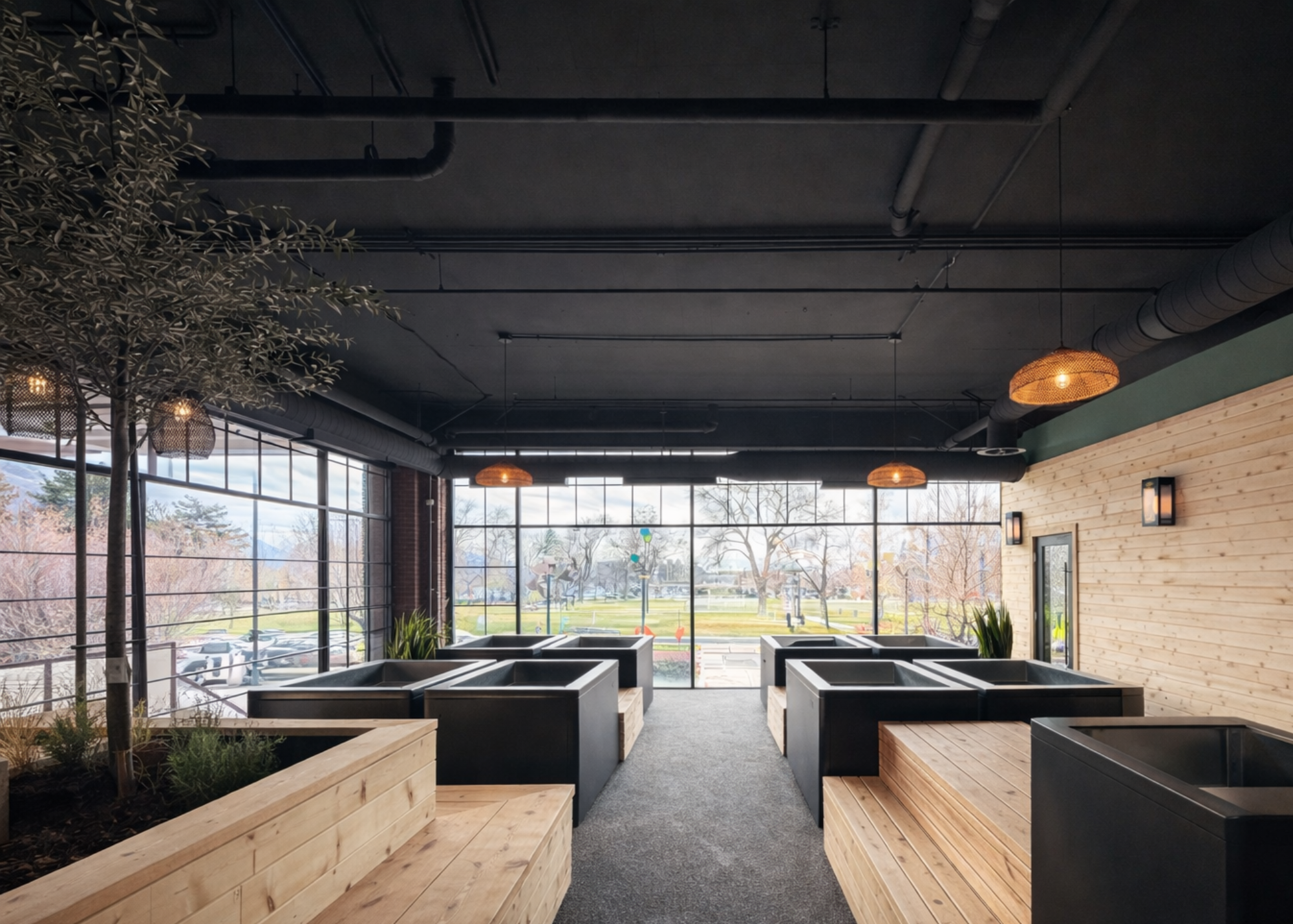
This is the entry-level layout. A great fit for operators who have existing space in a gym, med spa, chiropractor’s office, or wellness center, or who want to test the contrast therapy concept before scaling. The full buildout is essentially the equipment package — minimal interior construction, no showers, no additional plumbing, no individual rooms.
- Total cost: $35,000 to $50,000
- Equipment: Typically 3 to 4 saunas and 2 cold plunges in an open shared room
- Capacity: 12 to 15 people per hour
- Best for: Operators with existing space, lower upfront capital, or those validating the contrast therapy model before committing to a standalone buildout
Open community — 1,000 to 2,500 sqft
The layout for serious operators who want a standalone, scalable business — the kind of studio that can be replicated across multiple locations. Requires rinse showers between sauna and cold plunge sessions (to maintain water quality when customers transition between heat and cold) and changing areas with lockers.
- Total cost: $100,000 to $500,000 depending on equipment package, design, finish level, and market
- Equipment: 6 to 8 saunas and 8 to 10 cold plunges. Custom saunas at this scale typically run $30,000 to $150,000 depending on size and design
- Capacity: 500+ members before the space caps out
- Monthly revenue potential: $50,000 to $200,000 at full operation
- Best for: Operators with $100,000+ in startup capital, a market with strong demand for recovery services, and a multi-location vision
Private studio — 500 to 1,000 sqft
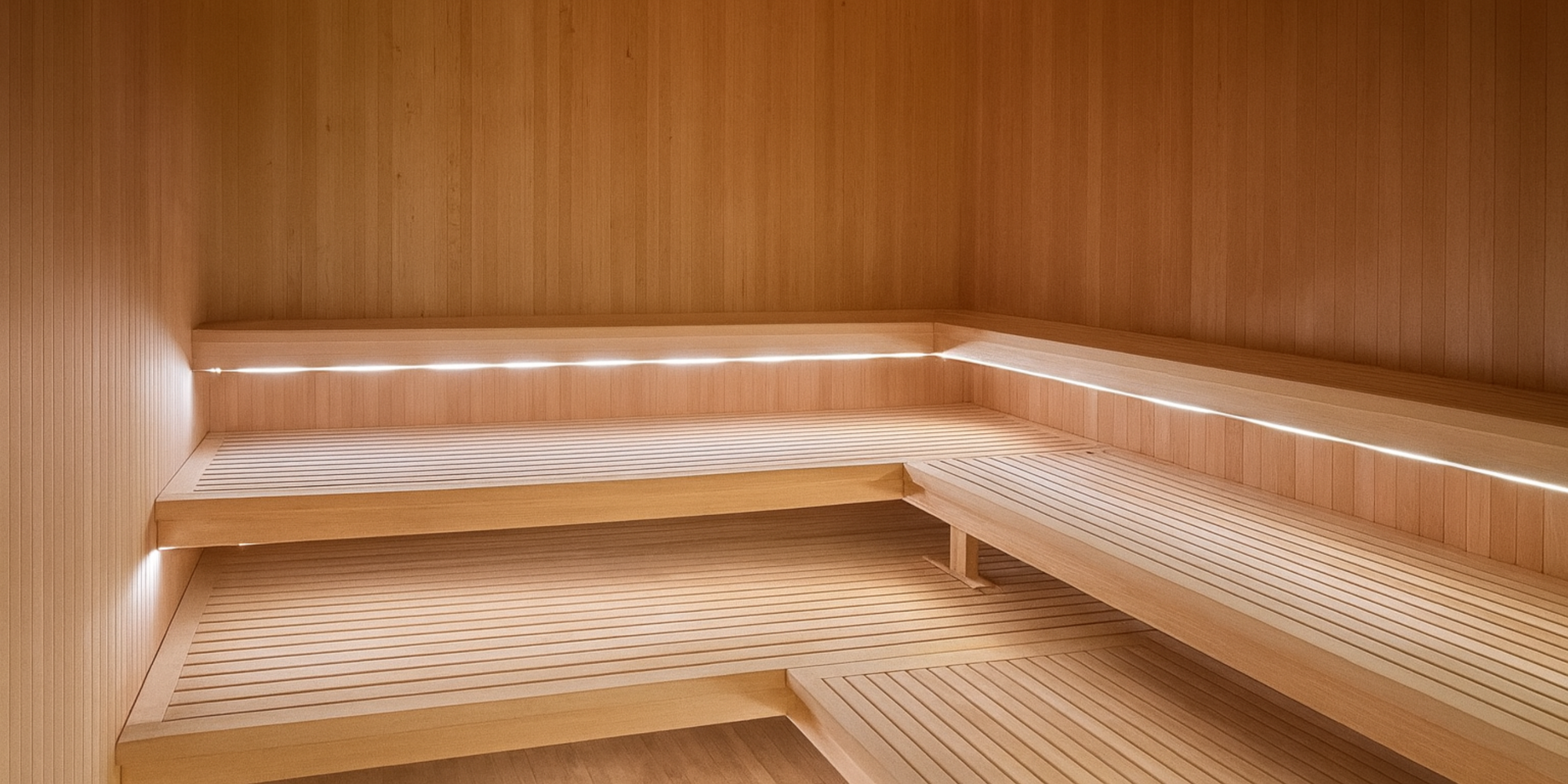
The premium experience format — private rooms instead of a shared open floor. Higher than the equivalent open community footprint because of interior walls, per-suite ventilation, and dedicated equipment per room. Each suite is typically 8x10 feet — large enough to deliver a premium experience without wasting square footage.
- Total cost: $40,000 to $80,000
- Equipment: $12,000 to $20,000 per room
- Number of suites: 3 to 5, with a maximum of 2 to 4 people per room
- Capacity: 8 to 16 people per hour
- Monthly revenue potential: $30,000 to $100,000
- Best for: Operators in affluent suburban areas, urban corridors, or markets with high-income recovery-conscious customers who will pay a premium for privacy
Private studio — 1,000 to 2,500 sqft
The full-scale premium concept — multiple private suites with dedicated plumbing per room, private showers in each suite, and the highest revenue ceiling of the four formats. Suites run 8x10 to 10x12 feet to maximize space efficiency while delivering a premium experience.
- Total cost: $150,000 to $500,000 depending on layout, finish level, and market
- Equipment: $12,000 to $20,000 per room
- Number of suites: 6 to 10
- Capacity: 12 to 40 people per hour
- Best for: Operators with $150,000+ in startup capital, a market that supports premium recovery pricing, and a business model focused on memberships plus high-margin single sessions
Contrast therapy studio layout comparison
Side-by-side across all four formats. Costs reflect 2026 U.S. market pricing; verify current figures with local contractors and equipment suppliers before committing capital.
Cost & equipment by format
| Format | Open Community 500–1,000 sqft | Open Community 1,000–2,500 sqft | Private Studio 500–1,000 sqft | Private Studio 1,000–2,500 sqft |
|---|---|---|---|---|
| Total cost | $35,000–$50,000 | $100,000–$500,000 | $40,000–$80,000 | $150,000–$500,000 |
| Equipment cost | $35,000–$50,000 (essentially the full buildout) | Included in total; custom saunas $30,000–$150,000 | $12,000–$20,000 per room | $12,000–$20,000 per room |
| Saunas | 3–4 | 6–8 | 1 per room | 1 per room |
| Cold plunges | 2 | 8–10 | 1 per room | 1 per room |
| Rooms / suites | N/A (open floor) | N/A (open floor) | 3–5 suites (8x10 ft) | 6–10 suites (8x10 to 10x12 ft) |
Capacity & revenue potential by format
| Format | Open Community 500–1,000 sqft | Open Community 1,000–2,500 sqft | Private Studio 500–1,000 sqft | Private Studio 1,000–2,500 sqft |
|---|---|---|---|---|
| Capacity (people/hr) | 12–15 | High volume | 8–16 | 12–40 |
| Member capacity | N/A | 500+ | N/A | High (membership + sessions) |
| Monthly revenue potential | N/A | $50,000–$200,000 | $30,000–$100,000 | High ceiling |
| Showers required | No | Yes (rinse showers) | No | Yes (private per suite) |
| Key additions | None — minimal buildout | Rinse showers, lockers, changing areas | Interior walls, per-suite ventilation | Private showers, dedicated plumbing per room, premium finish |
Cost ranges reflect 2026 U.S. market pricing. Coastal and major metro markets typically run 15% to 30% higher. Obtain firm quotes from local contractors and equipment suppliers before committing capital.
Where the money actually goes
For operators pricing out a 1,000–2,500 sqft buildout for the first time, the total cost number can feel abstract. Here’s how a typical $250,000 buildout breaks down by line item:
Typical $250,000 buildout breakdown
| Line item | % of total cost | Notes |
|---|---|---|
| Equipment (saunas, cold plunges, chillers) | 50% to 65% | The single largest line item — commercial-grade equipment lasts; residential-grade fails under commercial volume |
| Plumbing and electrical | 10% to 20% | Higher for private studios with per-suite showers; lower for open community concepts |
| Interior construction (walls, flooring, finish) | 10% to 15% | Premium finishes (custom tile, designer lighting, woodwork) push this higher |
| Design and architecture | 3% to 8% | Studios that skip design often have operational problems — sightlines, flow, and ventilation are easy to get wrong |
| Lockers, changing areas, signage, FF&E | 5% to 10% | Required for 1,000–2,500 sqft open community concepts |
| Permits, inspections, and contingency | 5% to 10% | Always budget contingency — commercial buildouts almost always run 10% to 15% over initial estimates |
Which concept is right for you?
The decision is rarely about which concept is “best” in the abstract — it’s about which concept matches your capital, your market, and your operational comfort zone.
Choose open community 500–1,000 sqft if…
You have existing space in a gym, med spa, or wellness center, want to test the model with $35,000 to $50,000, and don’t need showers or private rooms.
Choose open community 1,000–2,500 sqft if…
You have $100,000+ in startup capital, are in a market with strong demand, and want a scalable standalone business model that can be replicated across locations.
Choose private studio 500–1,000 sqft if…
You are in a premium market, have $40,000 to $80,000 in capital, and your customer base will pay more for privacy and a high-touch experience.
Choose private studio 1,000–2,500 sqft if…
You have $150,000+ in capital, want the highest-revenue layout, and have a market that supports premium membership pricing and high-margin single sessions.
Case study reference: Recovery District, West Covina
Recovery District in West Covina, California is an example of the framework working at the standalone scale. Founder Nicole worked with the LIT Method team on her studio buildout and presale strategy, and signed 75 founding members in her first 30 days of opening — generating approximately $7,500 in monthly recurring membership revenue from the founding cohort alone, a $90,000 annual run rate.
The buildout cost is one half of the equation; the presale framework that fills the studio with members is the other half. Operators evaluating a contrast therapy studio should price both the buildout and the customer acquisition strategy before committing capital. See LIT Method’s guide on getting your first 100 members for the customer acquisition framework.
A note on equipment selection
Equipment is 50% to 65% of total buildout cost, which makes it the highest-leverage decision in the project. The mistake to avoid: buying residential-grade equipment to save money on the initial buildout. Cold plunges and saunas in a commercial studio environment run 10 or more sessions per day — dramatically more demanding than residential use. Operators who buy residential-grade chillers, acrylic plunge tubs, or undersized saunas typically face equipment failures, water quality issues, and warranty disputes within the first 12 months.
The cost of replacing failed equipment plus lost revenue during downtime almost always exceeds the savings from buying cheaper upfront. LIT Method offers turnkey commercial buildouts including 316 stainless steel cold plunges, dual-heat hybrid saunas, external commercial-duty chillers, and SOPs — the same package used at Recovery District in West Covina, Dillon’s Health Spa in Boston, and Chill Health Club in Kansas City.
What this guide is not saying
This guide is not a quote. The cost ranges reflect typical 2026 buildouts in U.S. markets and will vary based on local labor costs, permit requirements, finish level, equipment selection, and market conditions. Operators in major metros (NYC, San Francisco, LA, Boston) should expect to land 15% to 30% above the ranges in this guide.
This guide also focuses on capital expense to open the studio. It does not cover ongoing operating expenses (rent, utilities, staff, insurance, maintenance) or customer acquisition costs — both of which are separate line items every operator should model before signing a lease.
Methodology: Cost ranges in this guide reflect 2026 commercial-grade equipment and buildout pricing observed across LIT Method studio partner builds in U.S. markets, including Recovery District (West Covina, California), Dillon’s Health Spa (Boston), and Chill Health Club (Kansas City). Specific costs vary by region, finish level, equipment selection, and market conditions. Operators should obtain firm quotes from local contractors and equipment suppliers before committing capital. Last reviewed: May 2026.
Frequently asked questions
How much does it cost to open a contrast therapy studio?
Most contrast therapy studios cost $50,000 to $500,000 to open, depending on layout, square footage, equipment package, and finish level. Open community concepts in 500 to 1,000 sqft cost $35,000 to $50,000. Open community in 1,000 to 2,500 sqft costs $100,000 to $500,000. Private studio in 500 to 1,000 sqft costs $40,000 to $80,000. Private studio in 1,000 to 2,500 sqft costs $150,000 to $500,000.
What is the cheapest way to open a contrast therapy studio?
The cheapest entry point is an open community concept in 500 to 1,000 sqft of existing space (gym, med spa, wellness center) at $35,000 to $50,000. This format requires no plumbing, no showers, and minimal interior construction — the buildout is essentially the equipment package itself.
How much can a contrast therapy studio make per month?
Monthly revenue depends on layout and capacity. Open community concepts in 1,000 to 2,500 sqft can generate $50,000 to $200,000 per month at full operation. Private studio concepts in 500 to 1,000 sqft can generate $30,000 to $100,000 per month. Private studios in 1,000 to 2,500 sqft can support higher revenue ceilings driven by membership pricing and premium single sessions. Actual revenue depends on member volume, pricing structure, and ancillary services.
How long does a contrast therapy studio buildout take?
Most commercial buildouts take 60 to 120 days from lease signing to opening day. Equipment lead times are typically 4 to 8 weeks; permitting and construction overlap with that timeline. Operators who run presale during construction use that window to build a founding membership before opening day.
Should I open an open community or private studio?
The decision depends on capital, market, and pricing strategy. Open community concepts are cheaper to build, support higher hourly capacity, and work in markets where customers prioritize price and community. Private studios cost more to build, support higher pricing per session and per membership, and work in markets where customers prioritize privacy and a premium experience. Operators in affluent suburban or urban-corridor markets typically lean private studio; operators in mid-market or community-driven locations typically lean open community.
Do I need showers in my contrast therapy studio?
Showers are required in 1,000 to 2,500 sqft open community concepts (rinse showers between sauna and cold plunge) and in 1,000 to 2,500 sqft private studio concepts (private showers per suite). Smaller open community concepts in existing space can operate without showers if customers can rinse off elsewhere in the facility. Skipping showers in a high-volume layout creates water quality issues and a worse customer experience.
What’s the biggest mistake operators make when budgeting a contrast therapy studio?
The two most common mistakes are (1) buying residential-grade equipment to save money upfront, which leads to equipment failures and replacement costs that exceed the original savings, and (2) under-budgeting contingency, which leaves the operator short of capital during the final stages of buildout. Always budget 10% to 15% contingency on top of the initial estimate.