
✓ Written by: Samantha Becker, Lead Writer & Content Strategist
✓ Expert Verified by: Justin Norris, Co-Founder of LIT Method
TL;DR: The Short Answer
Yes — for most healthy adults, you can go straight from a sauna into a cold plunge. That heat-to-cold transition is the entire basis of contrast therapy, and it's how the practice has been done in Finland and Japan for generations.
A standard session looks like this:
- 10–15 minutes in the sauna
- 2–3 minutes in the cold plunge
- Repeat for 3 total cycles
One important caveat: moving abruptly between extreme heat and cold puts real demand on your cardiovascular system. If you have a heart condition, uncontrolled high blood pressure, an arrhythmia, a respiratory condition, are pregnant, or have a history of fainting, talk to your doctor before starting contrast therapy — and consider cooling down with a lukewarm shower instead of a plunge.
What Is Contrast Therapy?
Contrast therapy alternates thermotherapy (infrared or traditional sauna heat) with cold water immersion (a cold plunge). The cycle — hot, cold, repeat — is the mechanism: heat dilates blood vessels and raises heart rate, cold constricts them, and moving between the two creates a vascular pumping effect that neither does alone.
LIT Method builds a third modality into every contrast system: photobiomodulation (red light therapy) is integrated from the start rather than sold as an add-on tower, so heat, cold, and light work together in one setup.
How to Do a Sauna-to-Cold-Plunge Session
| Step | Duration | What's happening |
|---|---|---|
| 1. Sauna | 10–15 min | Vasodilation, elevated heart rate, heat shock protein activation |
| 2. Cold plunge | 2–3 min | Vasoconstriction, cold shock response, norepinephrine release |
| 3. Repeat | 3 cycles total | The alternation drives the vascular pumping effect |
Beginner adjustments: start with 30–60 seconds in the cold rather than 2–3 minutes, keep your head above water, and focus on controlled breathing — the first 30 seconds is the hardest as your breathing and heart rate spike. Build duration gradually.
Do you have to end on cold? Traditional practice ends on cold, but ending warm is fine too, especially if you're plunging near bedtime and want your core temperature to fall naturally.
Can You Do the Cold Plunge First?
Yes. Because contrast therapy is fundamentally about cycling, you'll move from cold to hot and back regardless of where you begin. Most people start with heat because it's more comfortable to enter and makes the cold easier to tolerate — but starting cold works, and by the second cycle the sequence is identical either way.
What the Research Actually Shows
Here's where the evidence is strongest — and where it isn't. The best long-term data comes from Finnish cohort studies on sauna bathing specifically, not contrast therapy as a combined practice.
Sauna frequency and dementia risk. A 2017 study in Age and Ageing from the University of Eastern Finland followed 2,315 middle-aged men for a median of 20.7 years. Compared with men who used a sauna once weekly, those using one 4–7 times per week had a 66% lower risk of dementia and a 65% lower risk of Alzheimer's disease, after adjusting for age, alcohol, BMI, blood pressure, smoking, diabetes, prior heart attack, resting heart rate, and cholesterol.
Sauna frequency and mortality. The same Kuopio Ischaemic Heart Disease cohort found men using a sauna 4–7 times weekly had roughly 40% lower all-cause mortality than once-weekly users.
Three honest caveats on that research, which the study authors themselves emphasize:
- These are observational associations, not proof of causation.
- Participants were middle-aged Finnish men with lifelong sauna habits, often beginning in infancy. Researchers explicitly note that benefits from sauna use started later in life are not well established.
- The studies examined sauna alone — cold plunging was not part of the protocol, so these figures shouldn't be read as contrast-therapy outcomes.
What contrast therapy is better supported for: cold water immersion has reasonable evidence for reducing delayed-onset muscle soreness and supporting recovery after hard training. The heat-and-cold combination is widely used by athletes for recovery, and heat exposure activates heat shock proteins associated with cellular repair.
Contrast therapy is a wellness practice, not a medical treatment. It shouldn't replace medical care for any condition.
Is It Safe to Go From Hot to Cold?
For most healthy adults, yes — but this deserves a straight answer rather than a marketing one.
Going from a 180°F+ sauna into 37°F water triggers a cold shock response: an immediate spike in heart rate and blood pressure within the first 30 seconds. Cold constricts blood vessels and makes the heart work harder, while heat has just dilated them. That swing is what makes contrast therapy effective — and it's also why it isn't for everyone.
Talk to your doctor first if you have:
- Heart disease, arrhythmia, angina, or a recent cardiac event
- Uncontrolled or severe high blood pressure
- A respiratory condition such as asthma or COPD
- A history of fainting, Raynaud's, or cold sensitivity
- Pregnancy
- Medications affecting blood pressure or temperature regulation (diuretics, beta-blockers)
Practical safety guidance:
- Never plunge alone, especially when starting out
- Skip alcohol — it's implicated in most sauna-related cardiac events
- Hydrate before and after; heat and sweating dehydrate you
- Stand up slowly after the sauna — blood pressure drops can cause dizziness
- Keep your head above water and avoid breath-holding during the cold shock phase
- Exit immediately if you experience chest pain, dizziness, confusion, difficulty breathing, numbness, or uncontrollable shivering
- A lukewarm shower is a valid alternative to a plunge if abrupt cold isn't right for you
How Often Should You Do Contrast Therapy?
Based on the Finnish sauna research, 4–7 sessions per week is the frequency associated with the strongest long-term outcomes — though again, that data reflects sauna use, and the participants had lifelong habits.
For most people starting out, 2–3 sessions per week is a sensible entry point, building frequency as your tolerance develops. Consistency matters more than intensity.
The Benefits of Contrast Therapy
- Faster recovery. Alternating heat and cold creates a vascular pumping effect, helping flush metabolic waste and drive fresh blood into fatigued muscle more effectively than either alone.
- Better sleep. Heat-induced relaxation followed by cooling supports a calm wind-down; the post-session core temperature drop is associated with easier sleep onset.
- Reduced soreness. Cold immersion has reasonable evidence for reducing delayed-onset muscle soreness after hard training.
- Cellular repair support. Heat exposure activates heat shock proteins, which act as molecular chaperones supporting cellular stability.
- Mental reset. The cold shock response triggers a norepinephrine release many people describe as sharpening focus and mood.
LIT Contrast Therapy Bundles
Every LIT plunge runs 37°F to 107°F, so the same vessel handles both true cold immersion and a warm contrast bath.
Titan Bundles (Indoor/Outdoor, All-in-One Sauna)
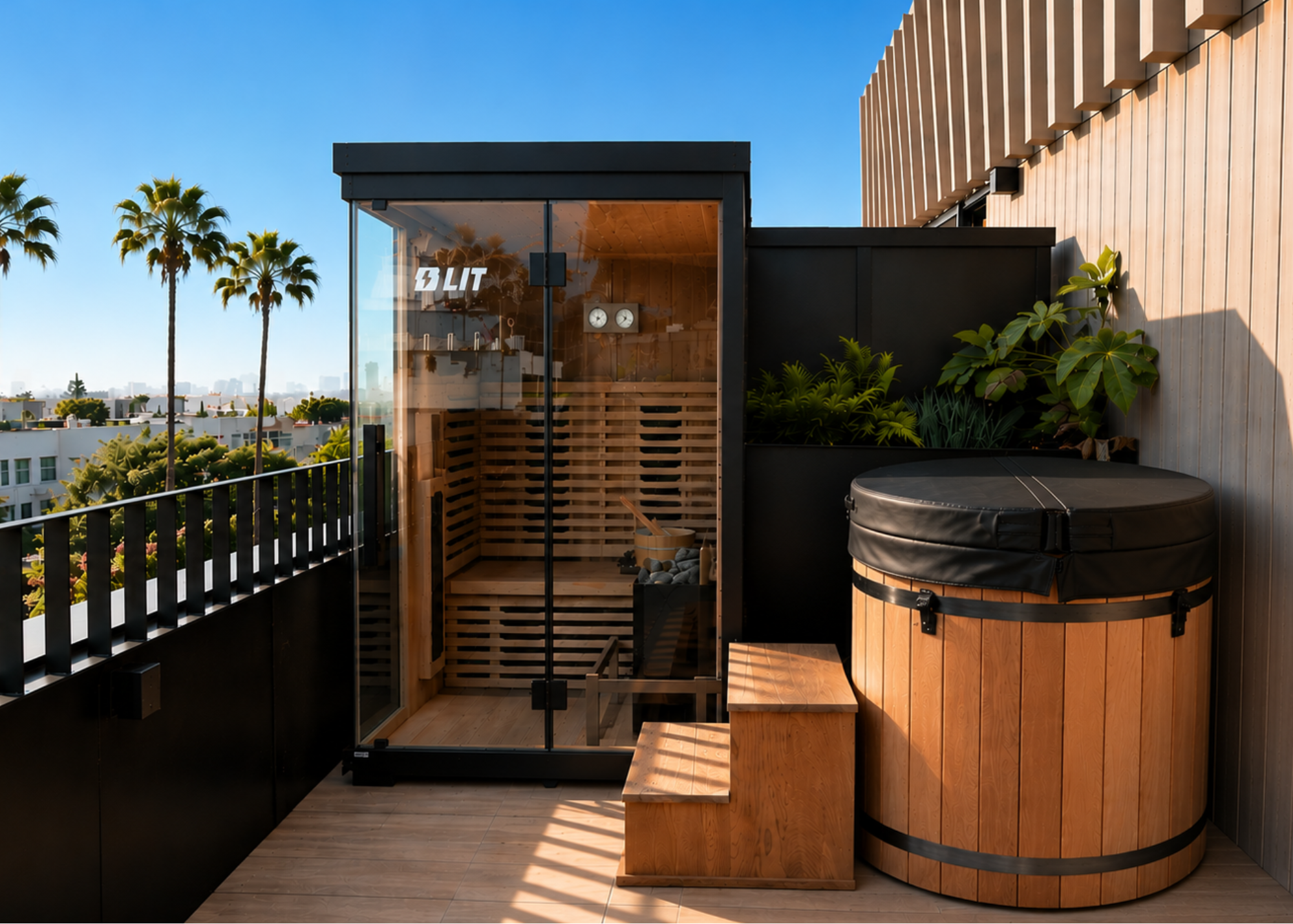
Stealth Black Plunge + Titan Sauna — LIT's bestselling system. The Titan is the world's first indoor/outdoor all-in-one sauna (traditional up to 200°F, infrared at 150°F, plus red light), paired with the Stealth plunge. 2-person cabin.
Stealth Black XL Plunge + Titan Sauna — the same pairing in a 4–5 person cabin.
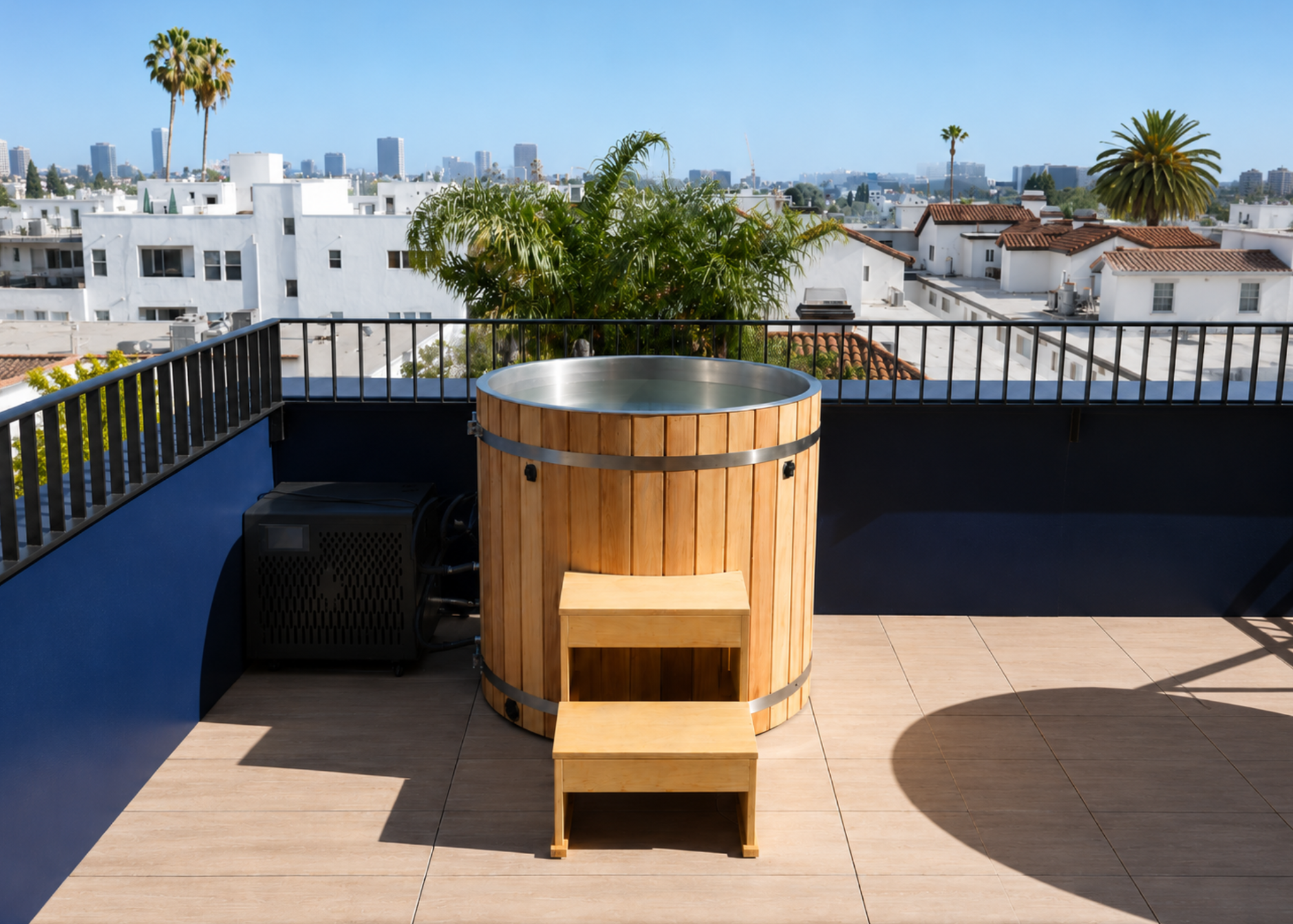
Stealth Luxe Barrel Plunge + Titan Sauna — the most space-efficient Titan bundle, using a compact barrel plunge without losing contrast benefits. (See Cold Plunge Barrel vs. Tub.)
BeautyBox Bundle (Indoor Infrared)
Stealth Plunge + BeautyBox Full Spectrum Infrared + Red Light Sauna — Esquire's Best At-Home Sauna of 2026, with low-EMF near, mid, and far infrared panels plus medical-grade red light. 2-person, indoor only.
Forge Bundle (Full Spectrum, Larger Groups)
Stealth Plunge + Forge Full Spectrum Infrared + Red Light Sauna — full-spectrum infrared to 170°F with medical-grade red light, paired with the Stealth Luxe stainless plunge. 3–4 person.
Solis Bundle (Traditional Heat)
Cedar Barrel Cold Plunge + Solis Traditional Sauna — traditional heat paired with a Pacific Cedar barrel plunge, fully insulated with a stainless or composite tank. 2–3 person, indoor.
Not sure which sauna to pair? See What Is a Hybrid Sauna? Infrared vs. Traditional vs. Hybrid vs. All-in-One.